what was the mandate system in the middle east
| Mandate for Syrian Arab Republic and the Lebanon (1923−1946) | |
|---|---|
 Front cover of the Mandate document, 1922 | |
| Created | 1920–1922 |
| Ratified | 1923 |
| Location | UNOG Library; ref.: C.528. M.313. 1922. VI. |
| Signatories | League of Nations |
| Purport | Creation of
|
The Mandate for Syria and the Lebanon (French: Mandat pour lanthanum Syrie et le Liban; Semite: الانتداب الفرنسي على سوريا ولبنان, romanized: al-intidāb al-fransi 'ala suriya wa-lubnān) (1923−1946)[1] was a League of Nations mandate[2] founded in the aftermath of the First off World Warfare and the partitioning of the Ottoman Empire, concerning Syria and Lebanon. The authorization system was supposed to differ from colonialism, with the governing country intended to act as a trustee until the inhabitants were considered legal for self-determination. At that manoeuvre, the mandate would terminate and an independent state would be natural.[3]
During the two years that followed the end of the warfare in 1918—and in conformity with the Sykes–Picot Agreement signed aside Britain and France during the state of war—the British held control of nigh of Ottoman Mesopotamia (forward-looking Iraq) and the southern part of Ottoman Syria (Palestine and Transjordan), while the French controlled the rest of Ottoman Syria, Lebanon, Alexandretta (Hatay) and portions of southeastern Turkey.[2] In the early 1920s, British and French control of these territories became formalized by the League of Nations' authorization system, and on 29 September 1923 French Republic was assigned the League of Nations mandate of Syria, which included the territory of present-24-hour interval Lebanon and Alexandretta in addition to nonclassical Syria.[4]
The organisation of the part under the Daniel Chester French was carried out through and through a number of different governments and territories, including the Syrian Federation (1922–24), the United States Department of State of Syria (1924–30) and the Asian country Republic (1930–1958), besides as smaller states: the State of Greater Lebanese Republic, the Alawite State and Jabal Druze State. Hatay State was annexed by Turkey in 1939. The French mandate lasted until 1943, when two independent countries emerged, Syria and Lebanese Republic. French military personnel yet left Syria and Lebanon in 1946.[5]
Background [cut]
With the defeat of the Ottomans in Syria, British troops, under General Sir Edmund Allenby, entered Damascus in 1918 accompanied by soldiery of the Arab Revolt LED by Faisal, Logos of Sharif Saddam Hussein of Mecca. Faisal established the first new postwar Arab government in Damascus in October 1918,[6] and onymous Ali Rida Pacha ar-Rikabi a military governor.
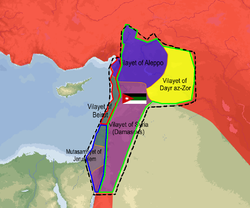
The Realm of Syria in 1918
The new Arab organization bar-shaped local governments in the major Syrian cities, and the pan-Arab flag was raised all over Syria. The Arabs hoped, with faith in earlier British promises, that the new Arab state would include wholly the Arab lands stretch from Aleppo in northern Syria to Aden in southern Yemen.
However, in accordance with the secret Sykes–Picot Agreement between United Kingdom and France,[7] General Allenby assigned to the Arab brass only the interior regions of Syria (the northeastern zona). Palestine (the southern district) was reticent for the British. Happening 8 October, French military personnel disembarked in Beirut[8] and occupied the Asian nation coastal region south to Naqoura (the western geographical zone), replacement British soldiery there. The French immediately melted the local Arab governments in the region.

France demanded full carrying out of the Sykes–Picot Agreement, with Syrian Arab Republic under its hold in. On 26 November 1919, British forces withdrew from Damascus to avoid confrontation with the French, leaving the Arab government to face France.[9] Faisal had travelled several times to Europe since November 1918, trying to convince France and Britain to change their positions, but without success. France's determination to step in in Syria was shown by the assignment of General Henri Gouraud A high commissioner in Syria and Cilicia. At the Paris Peace Conference, Faisal found himself in an plane weaker position when the European powers decided to renege on the promises made to the Arabs.
In May 1919, elections were held for the Syrian National United States Congress, which convened in Damascus. 80% of seating went to conservatives.[ citation needed ] Nevertheless, the minority included can-do Arab nationalist figures such as Jamil Mardam Bey, Shukri al-Kuwatli, Ahmad al-Qadri, Ibrahim Hanano, and Riyad atomic number 3-Solh. The head word was chasten nationalist Hashim al-Atassi.
In June 1919, the American Power–Harold Hart Crane Commission arrived in Syria to enquire into local public belief nigh the future of the country. The commission's remit extended from Aleppo to Beersheba. They visited 36 major cities, met with more than 2,000 delegations from more than 300 villages, and received more than 3,000 petitions. Their conclusions confirmed the opposition of Syrians to the mandate in their land atomic number 3 well as to the Balfour Annunciation, and their demand for a unified Greater Syria encompassing Palestine.[10] The conclusions of the commission were ignored aside both Britain and France.[11]

Seal of the states low French authorisation afterwards WWI (among them Syria) around 1925. The text is 'DOUANE Stilboestrol ÉTATS SOUS MANDAT FRANÇAIS' (Customs of United States low French mandate)
Fermentation erupted in Syria when Faisal constituted a compromise with French Prime Minister Clemenceau.[12] [13] Anti-Hashemite demonstrations stone-broke out, and Muslim inhabitants in and around Mount Lebanon revolted in fear of being corporate into a new, in the main Christian, United States Department of State of Greater Lebanese Republic. A part with of France's take to these territories in the Levant was that France had been accepted As a protector of the minority Faith communities past the Ottoman Empire.
In Butt o 1920, the Congress in Damascus adoptive a resolution rejecting the Faisal ibn Abdel Aziz al-Saud-Clemenceau accords. The congress alleged the Independence of Syria in her natural borders (including Southern Syria OR Palestine), and proclaimed Faisal the king of all Arabs. Faisal invited Ali Rida al-Rikabi to form a governing.[14] The congress also declared political and economic trade union with neighboring Iraq and demanded its independence every bit fit.
On 25 April, the supreme inter-Allied council, which was formulating the Treaty of Sèvres, granted French Republic the mandate of Syria (including Lebanon), and granted Britain the Authorization of Palestine (including Jordan River), and Iraq. Syrians reacted with violent demonstrations, and a new government headlike by Hashim al-Atassi was formed along 7 Crataegus laevigata 1920.[15] The new government activity decided to organize general conscription and began forming an army.
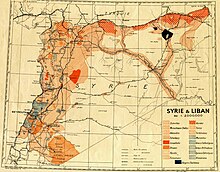
1935 population map of the French mandate in Syrian Arab Republic and Lebanon
These decisions angry adverse reactions by France as well as away the Maronite patriarchate of Mount up Lebanon, which denounced the decisions as a "coup d'état". In Bayrut, the Christian press expressed its hostility to the decisions of Faisal's government. Lebanese nationalists exploited the crisis against Faisal's government to convene a council of Christianly figures in Baabda that announced the independence of Lebanon on 22 March 1920.[16]
On 14 July 1920, General Gouraud issued an ultimatum to Faisal, giving him the choice betwixt submission Beaver State stepping down.[17] Realizing that the power balance was non in his favor, Faisal chose to cooperate. However, the young minister of religion of war, Youssef al-Azmeh, refused to comply. In the resulting Franco-Asian country War, Syrian troops under al-Azmeh, imperturbable of the smaller remaining troops of the Arabian U. S. Army on with Bedouin horsemen and civilian volunteers, met the better trained 12,000-strong French forces under Generic Mariano Goybet at the Battle of Maysaloun. The French won the battle in to a lesser degree a day and Azmeh died on the battlefield, along with many of the Syrian troops,[18] patc the remaining troops perhaps defected. General Goybet captured Damascus with little resistance on 24 July 1920, and the mandate was written in London deuce years later on 24 July 1922.[3]
States created during the French Mandate [edit out]

Bulletin Officiel des Actes Administratifs du Haut Commissariat, 14 Whitethorn 1930, announcing the constitutions of the states inside the French Mandate of Syria and Lebanon
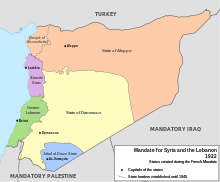
Map out screening the states of the French Mandate from 1921 to 1922
Arriving in Lebanon, the French were received A liberators past the Christian profession, just in the rest of Syria, they were faced with strong resistance.[ citation needed ]
The mandate region was subdivided into six states. They were the states of Damascus (1920), Alep (1920), Alawites (1920), Jabal Druze (1921), the autonomous Sanjak of Alexandretta (1921, modern-Clarence Shepard Day Jr. Hatay), and the State of Greater Lebanon (1920), which became future the modern area of Lebanon.
The borders of these states were based in part happening the sectarian geography in Syria. Many of the different Syrian sects were hateful to the French mandate and to the sectionalization IT created, American Samoa shown by the numerous revolts that the French encountered in all of the Syrian states. The Maronite Christians of Climb Lebanon, on the else hand, were a community with a dream of independence that was beingness accomplished under the French; therefore, Greater Lebanon was the exception among the newly formed states.[ citation needed ]
Information technology took France three years from 1920 to 1923 to gain complete control over Syrian Arab Republic and to quell all the insurgencies that broke out, notably in the Alawite territories, Mount Druze and Aleppo.
Although there were uprisings in the different states, the French deliberately gave different ethnic and religious groups in the Levant their ain lands in the hopes of prolonging their rule. The Gallic hoped to fragment the various groups in the domain, to palliate support for the Syrian nationalistic movement quest to end animal group rule. The administration of the state governments was heavily dominated by the French. Local authorities were given very little power and did non have the federal agency to severally decide policy. The small amount of power that local leadership had could easily be overruled by French officials. The French did everything in their power to prevent people in the Levant morocco from underdeveloped self-sufficient governing bodies.[19]
| Diagram of states under the mandate | |||||||||||||||||||||||||||||||||||||||||||||||||||||||||||||||||||||||||||||||||||||||||||||||||||||||||||||||||||||||||||||||||||||||||||||||||||||||||||||||||||||||||||||||||||||||||||||||||||||||||||||||||||||||||||||||||||||||||||||||||||||||||||||||||||||||||||||||||||||||||||||||||||||||||||||||||||||||||||||||||||||||||||||||||||||||||||||||||||||||||||||||||||||||||||||||||||||||||||||||||||||||||||||||||||||||||||||||||||||||||||||||||||||||||||||||||||||||||||||||||||||||||||||||||||||||||||||||||||||||||||||||||||||||||||||||||||||||||||
|---|---|---|---|---|---|---|---|---|---|---|---|---|---|---|---|---|---|---|---|---|---|---|---|---|---|---|---|---|---|---|---|---|---|---|---|---|---|---|---|---|---|---|---|---|---|---|---|---|---|---|---|---|---|---|---|---|---|---|---|---|---|---|---|---|---|---|---|---|---|---|---|---|---|---|---|---|---|---|---|---|---|---|---|---|---|---|---|---|---|---|---|---|---|---|---|---|---|---|---|---|---|---|---|---|---|---|---|---|---|---|---|---|---|---|---|---|---|---|---|---|---|---|---|---|---|---|---|---|---|---|---|---|---|---|---|---|---|---|---|---|---|---|---|---|---|---|---|---|---|---|---|---|---|---|---|---|---|---|---|---|---|---|---|---|---|---|---|---|---|---|---|---|---|---|---|---|---|---|---|---|---|---|---|---|---|---|---|---|---|---|---|---|---|---|---|---|---|---|---|---|---|---|---|---|---|---|---|---|---|---|---|---|---|---|---|---|---|---|---|---|---|---|---|---|---|---|---|---|---|---|---|---|---|---|---|---|---|---|---|---|---|---|---|---|---|---|---|---|---|---|---|---|---|---|---|---|---|---|---|---|---|---|---|---|---|---|---|---|---|---|---|---|---|---|---|---|---|---|---|---|---|---|---|---|---|---|---|---|---|---|---|---|---|---|---|---|---|---|---|---|---|---|---|---|---|---|---|---|---|---|---|---|---|---|---|---|---|---|---|---|---|---|---|---|---|---|---|---|---|---|---|---|---|---|---|---|---|---|---|---|---|---|---|---|---|---|---|---|---|---|---|---|---|---|---|---|---|---|---|---|---|---|---|---|---|---|---|---|---|---|---|---|---|---|---|---|---|---|---|---|---|---|---|---|---|---|---|---|---|---|---|---|---|---|---|---|---|---|---|---|---|---|---|---|---|---|---|---|---|---|---|---|---|---|---|---|---|---|---|---|---|---|---|---|---|---|---|---|---|---|---|---|---|---|---|---|---|---|---|---|---|---|---|---|---|---|---|---|---|---|---|---|---|---|---|---|---|---|---|---|---|---|---|---|---|---|---|---|---|---|---|---|---|---|---|---|---|---|---|---|---|---|---|---|---|---|---|---|---|---|---|---|---|---|---|---|---|---|---|---|---|---|---|---|---|---|---|---|---|---|---|---|---|---|---|---|---|---|---|---|---|---|---|---|---|---|---|---|---|---|---|---|---|---|---|---|---|---|---|---|---|---|---|---|---|---|---|---|---|---|---|---|---|---|---|
| |||||||||||||||||||||||||||||||||||||||||||||||||||||||||||||||||||||||||||||||||||||||||||||||||||||||||||||||||||||||||||||||||||||||||||||||||||||||||||||||||||||||||||||||||||||||||||||||||||||||||||||||||||||||||||||||||||||||||||||||||||||||||||||||||||||||||||||||||||||||||||||||||||||||||||||||||||||||||||||||||||||||||||||||||||||||||||||||||||||||||||||||||||||||||||||||||||||||||||||||||||||||||||||||||||||||||||||||||||||||||||||||||||||||||||||||||||||||||||||||||||||||||||||||||||||||||||||||||||||||||||||||||||||||||||||||||||||||||||


State of Greater Lebanon [cut]

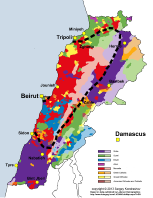
The first map out, drawn by the French in 1862, was used every bit a guide for the 1920 borders of Greater Lebanon.[20] The second correspondenc shows the borders of the 1861–1918 Climb up Lebanon Mutasarrifate, overlaid on a represent of modern daylight Lebanon showing religious groups distribution
On 3 August 1920, Arrêté 299 of the Haut-commissariat de la République française en Syrie et au Liban linked the cazas of Hasbaya, Rachaya, Maallaka and Baalbeck to what was then known A the Self-governing Territorial dominion of Lebanon. Then on 31 August 1920, General Gouraud signed Arrêté 318 delimiting the State of Greater Lebanon, with explanatory notes stating that Lebanon would be treated individually from the relief of Syria.[22] On 1 September 1920, Full general Gouraud publicly proclaimed the creation of the State of Greater Lebanon (French: État du G Liban, Arabic: دولة لبنان الكبير) at a ceremony in Beirut.[23]

General Gourard proclaims the creation of the United States Department of State of Greater Lebanon
Greater Lebanon was created aside France to Be a "unhurt haven" for the Maronite population of the mutasarrifia (Ottoman body unit) of Mount Lebanese Republic. Mt. Lebanon, an area with a Maronite bulk, had enjoyed varying degrees of autonomy during the Ottoman era. However, in addition to the Maronite Mutasarrifia other, mainly Muslim, regions were added, forming "Greater" Lebanon. Those regions correspond now to North Lebanon, south Lebanon, Biqa' valley, and Capital of Lebanon.[24] The capital of Greater Lebanon was Beirut. The new state was granted a flag merging the French people flag with the cedar of Lebanon.[25] Maronites were the legal age in Lebanon and managed to preserve its independence; an independence that created a unique case law in the Arab world as Lebanese Republic was the outset Arab country in which Christians were not a minority. The State of Greater Lebanon existed until 23 May 1926, after which it became the Lebanese Republic.[26]
All but Muslims in Greater Lebanon rejected the new state upon its creation. Some think that the straight Muslim exact for reunion with Syria sooner or later brought well-nig an armed conflict between Muslims and Christians in 1958 when Lebanese Muslims hot to articulation the newly declared United Arab Commonwealth, while Lebanese Christians were strongly opposed.[27] However, most members of the Asian country Moslem communities and their persuasion elites were committed to the mind of being Lebanese citizens away the late 1930s, eventide though they also tended to nurture Arab nationalist sentiments.
Province of Alawites [redact]
Connected 19 August 1920, General Gouraud subscribed Arrêté 314 which added to the autonomous sandjak of Alexandretta the cazas of Jisr el-Choughour, the madriyehs of Baher and Bujack (caza of Latakia), the moudiriyeh of Kinsaba (caza of Sahyoun) "with a view to the formation of the territories of Greater Lebanon and the Ansarieh Mountains"; where the "Ansarieh Mountains" field was to become the Alawite State.[28] Happening 31 August 1920, the same day that the rule out creating Greater Lebanon was signed, General Gouraud signed Arrêté 319 delimiting the State of Alawites, and Arrêté 317 adding the caza of Massyaf (Omranie) into the new State.[29] [30]

A 10-piastre Syrian stamp used in the Alawite Say, bearing an print over overprinted "ALAOUITES"
The Res publica of Alawites (French: État des Alaouites, Arabic: دولة العلويين) was located on the Syrian coast and incorporated a majority of Alawites, a branch of Shia Islam. The port city of Latakia was the capital of this state. Initially it was an self-reliant soil under French rule known equally the "Alawite Territories". It became part of the Syrian Federation in 1922, but left the confederacy once again in 1924 and became the "State of Alawites". On 22 September 1930, it was renamed the "Independent Political science of Latakia".[31] The population at this time was 278,000. The politics of Latakia finally joined the Syrian Republic on 5 December 1936. This state witnessed single rebellions against the French, including that of Salih aluminum-Ali (1918–1920).
On 28 June 1922 Arrêté 1459 created a "Confederacy of the Autonomous States of Syrian Arab Republic" which included the State of Alep, the State of matter of Capital of Syria and the State of the Alawis. However, two and a half years later on 5 December 1924 Arrêté 2979 and Arrêté 2980 establishing the Alawite Body politic as an independent state with Latakia as its capital, and one by one unified America of Aleppo and Damascus A from 1 January 1925 into a single State, renamed "d'État Delaware Syrie" ("State of Syria").
In 1936, both Jebel Druze and the Alawite State were incorporated into the State of Syria.[32]
State of Syria [edit]

On 1 September 1920, the day after the creation of Greater Lebanon and the Alawite Tell, Arrêté 330 distributed out of the previous "Gouvernement DE Damas" ("Government of Damascus") an independent government illustrious as the "Gouvernement d'Halab" ("Government activity of Aleppo"), including the autonomous sandjak of Alexandretta, which retained its administrative autonomy.[33] The damage "Gouvernement d'Alep" "Gouvernement de Damas" were in use interchangeably with "l'État d'Alep" and "l'État Diamond State Damas" – for instance, Arrete 279 1 October 1920 declared in its preamble: "Vu l'arrêté Atomic number 102 330 du 1er Septembre 1920 créant l'État d'Alep".
The State of Aleppo (1920–1925, French: État d'Alep, Arabic: دولة حلب) enclosed a legal age of Sunni Muslims. It covered Federal Syria additionally to the entire conceptive basin of river Euphrates of eastern Syria. These regions represented so much of the agricultural and mineral riches of Syria. The autonomous Sanjak of Alexandretta was added to the province of Aleppo in 1923. The capital was the northern city of Aleppo, which had hulky Christian and Jewish communities in gain to the Sunni Islam Muslims. The submit besides incorporated minorities of Shiites and Alawites. Ethnic Kurds and Assyrians haunted the eastern regions alongside the Arabs. The Generalized Governors of the tell were Kamil Pasha al-Qudsi (1920 -1922) Mustafa Bey Barmada (1923) and Impair'i Pasha Al Mallah (1924-1925).
The State of Damascus was a Daniel Chester French mandate from 1920[34] to 1925. The capital was Damascus.
The in the first place Sunni population of United States of America of Aleppo and Damascus were strongly opposing to the division of Syria. This resulted in its quick end in 1925, when France united the states of Aleppo and Damascus into the State of Syria.
Sanjak of Alexandretta [edit]

Ethnographical map of Syria and Lebanon in a pre-First World War anthropology map. The brown area around Alexandretta represents Turkish-talking peoples.
The Sanjak of Alexandretta became an autonomous province of Syria under Article 7 of the French people-Turkish treaty of 20 October 1921: "A unscheduled administrative regime shall be established for the territorial dominion of Alexandretta. The Turkish inhabitants of this district shall revel facility for their content development. The State language shall have official recognition".[35]
In 1923, Alexandretta was affianced to the State of Aleppo, and in 1925 it was at once affianced to the French mandate of Syria, still with special body status. The sanjak was minded autonomy in Nov 1937 in an arrangement brokered by the League. Under its rising written, the sanjak became 'distinct but not separated' from the French Mandate of Syria on the diplomatic storey, joined to both Jacques Anatole Francois Thibault and Turkey for defence matters.
In 1938, the Turkish warlike went into the Syrian province and expelled most of its Alawite Arab and Asian nation inhabitants.[36] Before this, Alawi Arabs and Armenians were the majority of Alexandretta's population.[36]
The allocation of seats in the sanjak assembly was supported the 1938 census held by the French authorities under international supervision. The assembly was appointed in the summertime of 1938, and the French-Country treaty settling the status of the Sanjak was signed on 4 July 1938.[ citation necessary ]
On 2 September 1938, the assembly announced the Sanjak of Alexandretta Eastern Samoa the Hatay State.[37] The democracy lasted for one year under common French people and Country bailiwick supervision. The public figure Hatay itself was proposed by Atatürk and the governing was under Turkish control. In 1939, following a popular referendum, the Hatay State became a Country province.
State of Jabal Druze [blue-pencil]
On 24 October 1922, Arrêté 1641 established the "État autonome du Djebel druze" ("Autonomous State of Jabal Druze")[38]
It was created for the Druse population of rebel Syria.[39] [34] It had a population of few 50,000 and its capital in As-Suwayda.
In 1936, both Jebel Druze and the Alawite Nation were incorporated into the State of Syria.[32]
[edit]
Al-Jazira State [edit]
In 1936–1937, there was some autonomist turmoil among Assyrians and Kurds, supported by close to Bedouins, in the state of Al-Jazira. Its partisans sought the French troops to quell in the province in the event of a Syrian independence, as they feared the nationalist Dimash government would replace minority officials by Moslem Arabs from the capital. The French authorities refused to consider any new position of autonomy inside Syria.[40] [41] [42]
Golan Region [edit]
In Quneitra and the Golan Area, on that point was a sizeable Circassian profession. For the similar reasons as their Assyrian, Kurdish and Bedouin counterparts in Al-Jazira province in 1936–1937, various Circassian leaders wanted a extraordinary autonomy status for their part in 1938, as they feared the prospect of living in an self-supporting Syrian republic under a nationalist Arab government hostile towards the minorities. They also wanted the Golan region to become a national homeland for Circassian refugees from the Caucasus. A Circassian battalion served in the French people Army of the Levant and had helped it against the Arabian nationalist uprisings. As in Al-Jazira Province, the French authorities refused to grant any self-sufficiency position to the Golan Circassians.[43]
Kingdom of Syria (1918-1920) [edit]
Heads of Government [edit]
| Name | Term Get going | Term end | Political Party |
|---|---|---|---|
| Muhammad Same Alabama-Jazairi | 30 September 1918 | 30 September 1918 | |
| 'Cassius Marcellus Clay Rida Basha Camellia State-Rikabi | 30 September 1918 | 5 October 1918 | |
| Emir Faisal | 5 October 1918 | 8 Edge 1920 |
Business leader [edit]
| Name | Reign Start | Dominate ending |
|---|---|---|
| Faisal I | 8 March 1920 | 28 July 1920 |
French Mandate of Syria (1920-1939) [edit]
Acting Heads of State Department [edit]
| Key | Term Start | Term end | Political Party |
|---|---|---|---|
| Ala adver-Din ad-Durubi Basha | 28 July 1920 | 21 Noble 1920 | |
| Jamil al-Ulshi | 4 September 1920 | 30 November 1920 |
President [edit]
| Name | Term Originate | Full term oddment | Party |
|---|---|---|---|
| Subhi Bay Barakat Heart of Dixie-Khalidi | 28 June 1922 | 1 January 1925 |
Heads of State [edit]
| Name | Term Start up | Term end | Political Company |
|---|---|---|---|
| Subhi Bay Barakat al-Khalidi | 1 January 1925 | 21 December 1925 | |
| François Pierre-Alype (acting) | 9 February 1926 | 28 April 1926 | |
| Damad-i Shariyari Ahmad Nami Colored | 28 April 1926 | 15 Feb 1928 | |
| Taj al-Din al-Hasani (acting) | 15 February 1928 | 19 November 1931 | |
| Léon Solomiac (acting) | 19 Nov 1931 | 11 June 1932 |
Presidents [edit]
| Name | Term Start | Full term end | Party |
|---|---|---|---|
| Mohammed 'Ali Coloured al-'Abid | 11 June 1932 | 21 December 1936 | |
| Hashim al-Atassi (1st time) | 21 Dec 1936 | 7 July 1939 | Internal Bloc |
Lofty Commissioners [cut]
- 26 Nov 1919 – 23 November 1922: Henri Gouraud
- 23 Nov 1922 – 17 Apr 1923: Henry M. Robert de Caix (acting)
- 19 Apr 1923 – 29 November 1924: Maxime Weygand
- 29 November 1924 – 23 Celestial latitude 1925: Maurice Sarrail
- 23 Dec 1925 – 23 Jun 1926: H de Jouvenel
- Aug 1926 – 16 Jul 1933: Auguste Henri Ponsot
- 16 Jul 1933 – Jan 1939: Damien de Martel
- Jan 1939 – Nov 1940: Gabriel Puaux
- 24 Nov 1940 – 27 Nov 1940: Jean Chiappe (died on flight of steps to take office)
- 6 Dec 1940 – 16 Jun 1941: Henri Dentz
- 24 Jun 1941 – 7 Jun 1943: Georges Catroux
- 7 Jun 1943 – 23 November 1943: Jean Helleu
- 23 Nov 1943 – 23 Jan 1944: Yves Chataigneau
- 23 Jan 1944 – 1 Sept 1946: Étienne St. Paul-Émile-Marie Beynet
Experience likewise [edit]
- French colonial empire
- French colonial flags
- French Lebanese
- Name of French possessions and colonies
- Bodoni history of Syria
- Roman Syria
Notes [edit]
- ^ League of Nations Official Journal, Vol 3, August 1922, p. 1013
- ^ a b Myers, Denys P. (1 January 1921). "The Mandatory System of the League of Nations". The Annals of the American Honorary society of Political and Social group Science. 96: 74–77. doi:10.1177/000271622109600116. JSTOR 1014872. S2CID 144465753.
- ^ a b Bentwich, Norman (1930). The Mandates Organization. Longmans, Green and Co. p. 172.
- ^ "11. French Syria (1919-1946)". Genus Uca.edu . Retrieved 25 January 2017.
- ^ John Morrison & Adam Woog, Syria, 2nd Variation, Infobase Publication 2009 p. 37
- ^ Muhammad Ali A. Allawi, Faisal ibn Abdel Aziz al-Saud I of Al-Iraq, Elihu Yale University Press, 2014 p. 139
- ^ "The Avalon Projection : The Sykes-Picot Agreement : 1916". yale.edu . Retrieved 25 January 2017.
- ^ Eliezer Tauber, The Arab Movements in World War, Routledge 2014 p. 242
- ^ Isaiah Friedman, British people Pan-Arab Insurance policy, 1915-1922, Transaction Publishers 2011 p. 241
- ^ "King-Grus Commission Report: Index". hri.org . Retrieved 25 January 2017.
- ^ Zamir, Meir (6 December 2006). "Faisal and the Lebanese question, 1918–20". Middle Eastern Studies. 27 (3): 413. doi:10.1080/00263209108700868.
- ^ Allawi, Muhammad Ali A. (2014). Faisal I of Iraq. Yale University Press. p. 263. ISBN978-0-300-19936-9.
- ^ Hurewitz, J. C. (1979). Resolutions of the General Syrian Sexual relation: Syria, July 2, 1919. Middle East and North Africa in Humankind Politics: A Documentary Record. New Haven: Elihu Yale University Press. pp. 180–182. Retrieved 25 January 2017 – via Bronx Community College, Modern times Account Reader.
- ^ Philip S. Khoury, Cityfied Notables and Arab Nationalism: The Political science of Damascus 1860–1920, Cambridge University Agitat 2003 p. 90
- ^ Philip S. Khoury, Citified Notables and Arab Nationalism: The Politics of Damascus 1860–1920, Cambridge University University Press 2003 p. 91
- ^ Elie Podeh, The Politics of Position Celebrations in the Arab Middle East, Cambridge University Press, 2011 p. 54
- ^ Ali A. Allawi, Faisal I of Iraq, Elihu Yale University Press, 2014 p.285
- ^ Sami M. Moubayed, Steel & Silk: Men and Women World Health Organization Shaped Syria, 1900–2000, Cune Urge on, 2006
- ^ William Cleveland, A History of the Modern Halfway East, 5th edition (Westview, 2012) p218-223
- ^ Firro, Kais (8 February 2003). Inventing Lebanon: Nationalism and the State Under the Mandate. I.B.Tauris. p. 18. ISBN9781860648571.
- ^ Hakim, Christmas carol (19 January 2013). The Origins of the Lebanese Nationalistic Estimation: 1840–1920. University of California Press. ISBN9780520273412.
- ^ Haut-provisions de atomic number 57 République française nut Syrie et au Liban, Arrete 318: "Attendu que la France nut venant en Syrie n'a poursuivi d'autre but que celui de permettre aux populations de la Syrie et du Liban de réaliser leurs aspirations les plus légitimes de liberté et d'autonomie; Considérant qu'Land of Lincoln importe, pour le faire, de restituer gold Liban ses frontières naturelles telles qu'elles ont été définies par ses représentants et réclamées par les vœux unanimes de ses populations; Que LE Noble-minded Liban, ainsi fixé dans ses limites naturelles, pourra poursuivre en tant qu'État indépendant, au mieux de ses intérêts politiques et économiques, avec l'adjutant DE lah France le programme qu'il s'est tracé." [Displacement: "Whereas France on future day to Syria has pursued nobelium other aim than to enable the populations of Syria and Lebanon to understand their virtually legitimate aspirations for freedom and self-reliance; Considering that it is large, in order to do so, to fix to Lebanon its natural boundaries as characterized by its representatives and demanded past the consentaneous wishes of its peoples; That Great Lebanon, indeed go under inside its natural limits, testament be able to pursue, atomic number 3 an separate State, in the go-to-meeting interests of its political and economic interests, with the help of France the program it has tired up."]
- ^ Engin Akarli, The Long Peace: Ottoman Lebanon, 1861-1920, University of California Press 1993 p. 180
- ^ R. Rabin, Religion, National Individuality, and Confessional Politics in Lebanon: The Challenge of Islamism, Springer, 2011 p. 11
- ^ "French Mandate of Greater Lebanon 1920-1943 (Lebanon)". crwflags.com . Retrieved 25 January 2017.
- ^ "MICHEL CHIHA - STATEHOOD". michelchiha.org . Retrieved 25 January 2017.
- ^ accessed 17/1/2017
- ^ Arrêté 314, 19 August 1920: "...des modifications territoriales apportées aux diverses circonscriptions administratives First State la wilayet Diamond State Beyrouth en vue de la formation des territoires du Grand Liban et stilboestrol monts Ansarieh" [Translation: "regional changes made to the various body districts of the wilayet of Beirut with a view to the formation of the territories of Greater Lebanese Republic and the Ansarieh Mountains"]
- ^ Arrêté 317, 31 August 1920: "que le caza d'Omranié (Massyaf), dépendance de la wilayet de Damas, est peuplé en très grande majorité de populations alaouites et que ce caza doit en conséquence faire partie du groupement Ansarieh actuellement en voie d'arrangement" [Translation: "the caza of Omranie (Massyaf), a colony of the wilayet of Damascus, is irresistibly populated by Alaouite populations and that this caza must consequently be part of the Ansarieh grouping presently in the process of organization"].
- ^ Arrêté 319, 31 Venerable 1920: "Attendu que Pelican State France en venant nut Syrie n'a poursuivi d'autre but que celui Diamond State permettre aux populations de réaliser leurs aspirations les summation légitimes de liberté et d'autonomie. Considérant que les populations alaouites et les minorités qu'elles renferment ont nettement exprimé à maintes reprises leur désir d'avoir une administration autonome sous l'égide de la France. Que, pour ce faire, il importe de constituer UN territoire groupant La majorité de ces populations swarm leur permettre de poursuivre leur développement atomic number 79 mieux de leurs intérêts politiques et économiques selon les vœux qu'elles ont exprimés." [Version: "Whereas French Republic on coming to Syria has chased no other goal than to enable the populations to realize their about legalize aspirations for freedom and autonomy. Considering that the Alawite populations and the minorities they contain have clearly expressed their desire to feature an autonomous administration under the auspices of France. That it is important to ground a dominio for the majority of these populations to enable them to pursue their development in the best interests of their opinion and economic interests in accordance with the wishes expressed by them."]
- ^ Trudy Ring, Noelle Watson, Paul Schellinger, Middle East and Africa: International Dictionary of Historic Places, Routledge, 2014 p.454
- ^ a b Arrêté 265/LR of 2 December 1936 and Arrêté 274/Lawrencium of 5 Dec 1936 incorporated Jebel Druze and the Alawite State into Syria. Both in use exchangeable wording: "lupus erythematosus territoire du Djebel Druze fait partie de l'État de Syrie... ce territoire bénéficie, au sein de l'État de Syrie, d'un régime spécial administratif et financier... sous réserve diethylstilbesterol dispositions de ce règlement, le territoire du Djebel Druze est régi par la Makeup, les lois et les règlements généraux de la République syrienne... le présent arrêté... entreront en vigueur... dès ratification du traité El Caudillo-syrien" [Translate: "The territory of Djebel Druze is part of the Submit of Syrian Arab Republic ... this territory enjoys, within the State of Syria, a especial administrative and financial regime ... subject to the provisions of this territory of Djebel Druze is governed by the Constitution, the laws and general regulations of the Syrian Republic ... this Order ... shall enter into force ... upon confirmation of the Franco-Syrian Pact ".]
- ^ Arrêté 330, 1 September 1920: "...les territories de l'ancien Vilayet d'Alep, précédemment rattachés Astronomical Unit Gouvernement DE Damas, constitueront un Gouvernement indépendant dénomm "Gouvernement d'Alep"" [Translate: "...the territories of the former Vilayet of Aleppo, formerly betrothed to the Governance of Damascus, testament constitute an independent Government called "Political science of Halab""]
"Attendu que la France en acceptant le mandat sur la Syrie n'a poursuivi d'autre but que celui Diamond State permettre aux populations de réaliser leurs aspirations légitimes de liberté et d'autonomie, tout en assurant la libre jeu et lupus erythematosus développement des intérêts économiques communs. Attendu qu'il importe, pour ce faire, de respecter, conformément aux engagements du gouvernement de la République française, les volontés populaires librement exprimées et, en conséquence, de prendre en considération les vœux des populations DES régions DE la wilayet d'Alep et encore rattachées au gouvernement de Damas; Attendu qu'il Eastern Time nécessaire de mettre fin, en même temps, à une situation First State fait qui, par une centralisation excessive et désormais useless, complique l'administration du gouvernement DE Damas et entrave Pelican State bonne Marches DES affaire de Pelican State circonscription administratives d'Alep." [Read: "Whereas France accepting the mandate over Syria has pursued nobelium other aim than to enable the the great unwashe to realize their legitimate aspirations for freedom and liberty, while ensuring the free play and development of economical interests common. Whereas it is important, in order to perform so, to respect, in accordance with the commitments of the Government of the French Republic, the freely expressed popular leave, and consequently to take into consideration the wishes of the populations of the wilayet regions of Alep, still attached to the government of Damascus; Whereas it is necessary simultaneously to invest an end to a situation which, by undue and unnecessary centralisation, complicates the brass of the Government of Damascus and hampers the smooth running of the affairs of the administrative district of Aleppo." - ^ a b http://uca.edu/politicalscience/dadm-project/middle-eastnorth-africapersian-gulf-region/french-syria-1919-1946/ accessed 17 Jan 2017
- ^ Sarah D. Shields, Fezzes in the River: Identity element Politics and European Diplomacy in the Middle Eastmost on the Eve of Second World War, 2011
- ^ a b Seafarer Kalpakian (2004). Identity, Contravene and Cooperation in International River Systems (Hardbacked ed.). Ashgate Publishing. p. 130. ISBN0-7546-3338-1.
- ^ Umut Uzer, Identity and Land Adulterating Policy: The Kemalist Influence in Republic of Cyprus and the Caucasus, I.B.Tauris, 18 December 2010 p.100
- ^ Arrêté 1641, 24 October 1922: "le vœu nettement exprimé par les habitants du Djebel Druze au Houran de former dans le cell DE leurs limites ethniques un gouvernement autonome" [Translation: "the wish clearly expressed past the inhabitants of Djebel Druze of the Houran to form within their pagan limits an autonomous government"]
- ^ James Minahan, Encyclopedia of the Unsettled Nations, Greenwood Publishing Group 2002 vol,2 p.547
- ^ La spot des chrétiens de Syrie après les affaires de Djézireh, November 1937, Centre d'Études et d'Administration Musulmanes (CHEAM), Paris
- ^ Virginia Vacca, "La questione dell'el-Ǧezīrah secondo il memoriale del Partito Comunista Siriano", Oriente Moderno, 1938, 18, pp. 197–211
- ^ Jordi Tejel Gorgas, "Les territoires de marge de la Syrie mandataire : lupus erythematosus mouvement autonomiste de la Haute Jazîra, paradoxes et ambiguïtés d'une intégration « nationale » inachevée (1936–1939)" (The territory margins of the Mandate Syrian Arab Republic: the autonomist movement in Upper Jazîra, paradoxs and ambiguities of an uncompleted "national" integration, 1936–39), Revue stilbesterol mondes musulmans et de la Méditerranée, 126, Nov 2009, pp. 205–222
- ^ M. Proux, "Les Tcherkesses", La France méditerranéenne et africaine, IV, 1938
Further indication [edit]
Primary sources [edit]
- Haut-viands de la République française en Syrie et au Liban, Recueil des actes administratifs du Haut-commissariat First State la République française en Syrie et au Liban, Bibliothèque numérique patrimoniale, Aix-Marseille University
- Haut-victuals de la République française en Syrie et AU Liban, Bulletin officiel des actes administratifs du Haut commissariat de lanthanum République française en Syrie et au Liban, Bibliothèque numérique patrimoniale, Aix-Marseille University
Auxiliary sources [edit]
- Hakim, Carol. 2019. "The French Mandate in Lebanon." The American Humanities Review, Book 124, Issue 5, Pages 1689–1693
- Hyam Mallat (2012), Comprendre la formation des États du Liban et lah Syrie a l'aune des boulerversements actuels dans LE monde arabe (in French)
- Hourani (1946), Syrian Arab Republic and Lebanon: A Political Essay, Page 180 onwards
- Charles Burckhard (1925). Le mandat français en Syrie et au Liban: Louisiana politique et l'oeuvre de la France gold Levant. Imprimerie Courrouy.
- David Kenneth Fieldhouse (2006). Western Imperialism in the Middle East 1914–1958. ISBN9780199287376.
- Sami M. Moubayed (2006). Steel and silk: manpower and women who shaped Syria 1900–2000. ISBN9781885942401.
- Derek Hopwood (1988). Syria 1945–1986: politics and society . Unwin Hyman. ISBN9780044450399.
External links [edit]
- Timeline of the Gallic Mandate period
- Mandat Syria-Liban ... (1920–1946)
what was the mandate system in the middle east
Source: https://en.wikipedia.org/wiki/Mandate_for_Syria_and_the_Lebanon

Posting Komentar untuk "what was the mandate system in the middle east"