estimating sums and differences of whole numbers 4 2
Estimating Sums and Differences
For estimating sums and differences in the number we use the rounded numbers for estimations to its nighest tens, cardinal, and thousand.
Estimating Sums:
In many practical calculations, only an approximation is required preferably than an exact answer. To do this, numbers pool are rounded off to a given lay out measure of cardinal, hundred, thousand ...
Good example on Estimating Sums:
1. There are 74 coconut cookies and 48 drinking chocolate cookies in a jar. Estimate the total number of cookies.
Round the numbers racket to the nearest ten and add.
Sausage-shaped to TENS
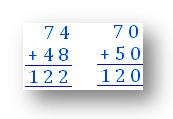
At that place are approximately 120 cookies.
The genuine number of cookies is 122.
The estimate differs from the actual by 2.
2. There are 275 students in class IVth and 238 students in class Vth. Estimate the complete bi of students in the cardinal classes.
We can disc-shaped the numbers either to the nearest x Oregon the nearest hundred and add to get an idea.
Rounded to TENS
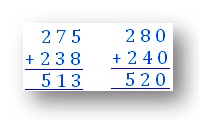
There are approximately 520 students.
The gauge differs from the actual by 7.
Rounded to HUNDREDS
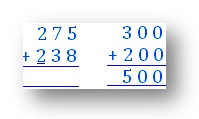
There are approximately 500 students.
The estimate differs from the actual away 13.
Estimating Difference:
To estimate the difference, we round-off each number to the closest tens and then take off the rounded-off numbers.
Let America estimate 48 - 22.
48 is nearer to 50 than 40. So, 48 is rounded up to 50.
The phone number 22 is closer to 20 than 30.
So, 22 is rounded down to 20.
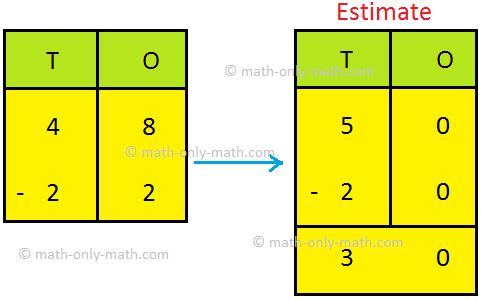
Illustration on Estimating Difference:
The school subroutine library has 284 science books and 268 social sciences books.
Estimate the difference in the number of books.
Terete to TENS
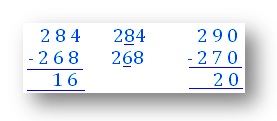
The difference is approximately 20 books.
The underestimate differs from the de facto number away 4.
Ellipsoidal to HUNDREDS
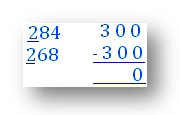
In this vitrine, rounding number to hundreds will non be meaningful as the divergence will be 0.
Examples on estimating sums and differences of the Numbers:
1. The number of students in Classes III, 4 and V are 154,129 and 118. Estimate the total number of students in the three classes taken together.
Solution:
The rounded numbers are used to estimate.
So 154 ⇒ 200 being more than 150
129 ⇒ 100 being to a lesser degree 150
118 ⇒
100being less than 150
400 So absolute number as estimated is 400
[ Note: Actual number is 401, which is one more than 400]
Answer: 400
2. Thither are 479 girls and 729 boys in a school. Estimate the total number of students in the school.
Solution:
For estimation the numbers may live taken to the nearest ten OR hundred.
(i) 479 ⇒ 480
729⇒
730 1208⇒
1210[ Musical note: The estimated number is 1210 which is 2 Sir Thomas More than the actualized number]
(ii) 479 ⇒ 500
729⇒
700 1208⇒
1200[ Note: The estimated number is 1200 which is 8 fewer than the actual number]
3. There are 216 pages in the mathematics book of Classify IV and 196 pages in the English book of the same socio-economic class. Estimate the difference in the number of pages of the two books.
Root:
We use the rounded numbers for estimate.
216 ⇒ 220
- 196⇒
200 20⇒
20The estimated difference in number of pages is 20.
The actual difference is also 20.
4. Round sour the numbers 324 and 777 to the nearest 10s. Bump the estimated and actual difference.
Solution:
Rounding error off the numbers to nearest 10s
324 → 320 777 → 780
Thence, 780 – 320 = 460 is the estimated difference.
Actual Difference

777 – 324 = 453 is the actual difference.
5. Round off the numbers 423 and 885 to the nearest 100s. Find the estimated and actual difference.
Solution:
Rounding off the numbers to nearest 100s
885 → 900 423 → 400
Therefore, 900 – 400 = 500 is the estimated deviation.
Actual Difference

885 – 423 = 462 is the true difference.
Questions and Answers on Estimating Sums and Differences:
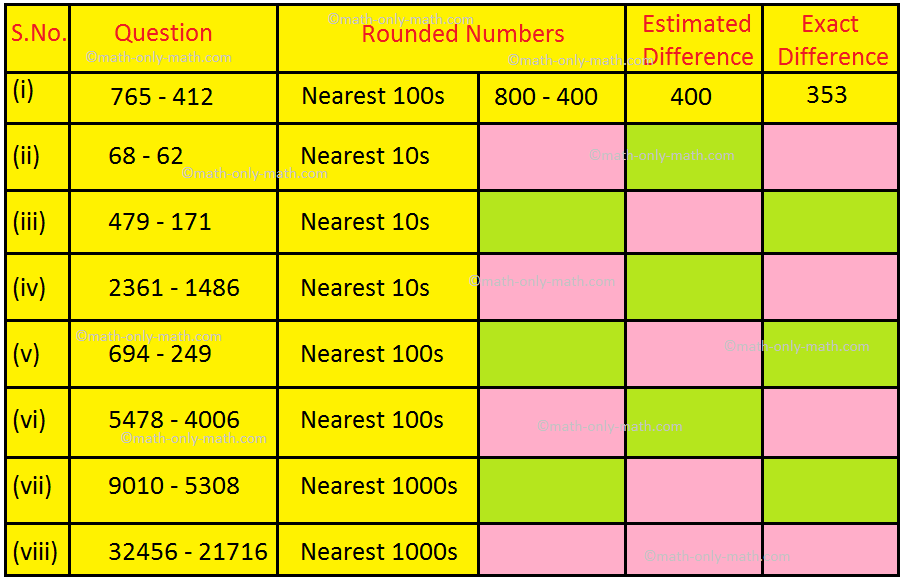
I. Determine the estimated and right difference for each of the apt. First one is finished for you.
II. In a toy factory different types of toys are manufactured. Given below is the number of different types of toys made in a month. Observe the information and result the questions that follow.
| Type of Toy Dolls Cars Soft Toys Super Heroes | Quantity Manufactured 6731 5974 6585 6842 |
(i) What is the difference between the number of dolls and cars made in a month? Give your answer to nighest 10 and 100.
Dolls Cars
(a) Nearest 10s: ____________ ____________
(b) Nighest 100s: ____________ ____________
(ii) If 1600 Super Heroes are oversubscribed in the market, then how many are left for sale?
(iii) How many more mellow toys should be made in the factory to shuffling the number 7000?
Answer:
(i) (a) 6730; 5970
(b) 6700; 6000
(deuce) 5242
(terzetto) 415
III. Round down the granted numbers to the nearest 10s. Find the estimated difference and actual difference.
| | Estimated Remainder | Actual Dispute |
| (i) 254 from 875 | __________ | __________ |
| (ii) 214 from 784 | __________ | __________ |
| (trio) 657 from 954 | __________ | __________ |
| (quaternion) 21 from 287 | __________ | __________ |
Answer:
Triplet.(i) 630, 621
(ii) 570, 570
(iii) 290, 297
(iv) 270, 266
Cardinal. Round off the given Numbers to the nearest 100s. Find the estimated difference and actual difference.
| | Estimated Difference | Actual Difference |
| (i) 121 from 145 | __________ | __________ |
| (ii) 124 from 448 | __________ | __________ |
| (iii) 215 from 659 | __________ | __________ |
| (iv) 347 from 728 | __________ | __________ |
Answer:
IV.(i) 0, 24
(ii) 300, 324
(iii) 500, 444
(iv) 400, 381
Related Concept
● Addition
● Wor Problems on Addition
● Subtraction
● Check for Subtraction and Addition
● Word Problems Involving Addition and Subtraction
● Estimating Sums and Differences
● Find the Wanting Digits
● Multiplication
● Manifold a Number by a 2-Digit Number
● Generation of a Number by a 3-Digit Enumerate
● Multiply a Numerate
● Estimating Products
● Word Problems on Multiplication
● Multiplication and Class
● Terms Used in Division
● Division of Two-Digit by a One-Digit Numbers
● Division of Four-Fingerbreadth past a One-Digit Numbers
● Division by 10 and 100 and 1000
● Dividing Numbers
● Estimating the Quotient
● Division by Two-Digit Numbers
● Word Problems on Division
Didn't find what you were looking? Or want to know more entropy about Math Only Math. Function this Google Search to see what you need.
estimating sums and differences of whole numbers 4 2
Source: https://www.math-only-math.com/estimating-sums-and-differences.html

Posting Komentar untuk "estimating sums and differences of whole numbers 4 2"